
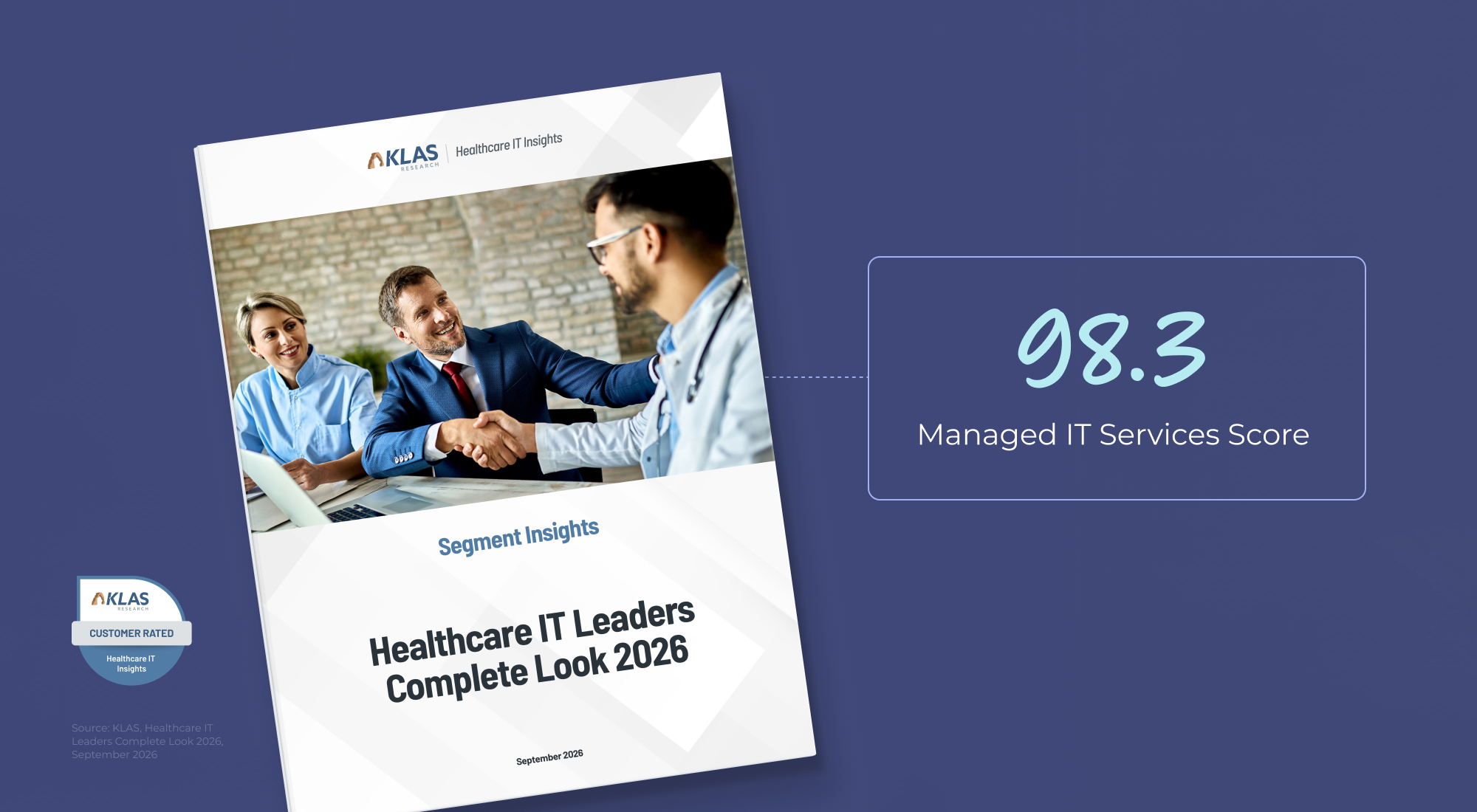
One healthcare CIO described frequent overnight calls about IT problems. After partnering with Healthcare IT Leaders, those calls stopped. The CIO shared that experience in Healthcare IT Leaders Complete Look 2026, published by KLAS Research in September 2026.
In the report, client respondents rated Healthcare IT Leaders 98.3 out of 100 in the KLAS Managed IT Services category. The CIO comments describe the support behind that experience and they line up with what we’ve seen across other engagements, including our recent work with Baptist Health and USA Health.
Our Continuous Managed Services offering supports EHR and ERP healthcare applications through ongoing monitoring and application managed services (AMS). Here is how the CIO’s feedback connects with those capabilities.
Around the clock support
After-hours coverage affects the people responsible for keeping EHR clinical systems available for care providers. Our Continuous Managed Services model includes 24/7 monitoring and application support. For this CIO, the change was visible in their overnight workload.
“With Healthcare IT Leaders, I don’t get calls anymore in the middle of the night. Before we implemented the partnership with Healthcare IT Leaders, it was not unusual for me to get calls two or three times a night because of different problems happening. I haven’t received a single call since we started working with Healthcare IT Leaders….”
CIO (managed IT services), collected by KLAS Research, September 2026
For teams that can’t staff every shift themselves, the CIO’s experience points to a practical question: do you have the resource capacity to manage around-the-clock support for your enterprise systems? Our Baptist Health Continuous Managed Services case study walks through what that coverage looked like in practice — including alert monitoring that resolved more than 100 open alerts and self-healing operations jobs that cut down manual intervention. When issues do arise, users should be able to quickly reach application experts for prioritized support and rapid resolution.
Performance against service commitments
Our service-level agreements (SLAs) set expectations for support, and performance reporting shows how we deliver against them. This CIO commented on the measures directly:
“. . . Healthcare IT Leaders is exceeding the SLAs. When I’ve looked at the call volumes, answer times, and first-call resolutions, they’re above what we expected and above what they committed to. . . .”
CIO (managed IT services), collected by KLAS Research, September 2026
It’s important to have transparent service level agreements and performance reporting to ensure accountability and continuous improvement. Real-time reporting will give both teams a basis for discussing performance and adjusting priorities. Because at the end of every support ticket or call is a patient in need of quality care delivery.
Knowledge of the applications you use
Application support depends on understanding the systems your teams use. Our operational model is platform agnostic, covering EHR and ERP application management across Epic, Oracle Health, Workday, and UKG. The CIO pointed to application knowledge as an important factor in selecting Healthcare IT Leaders.
“. . . What set Healthcare IT Leaders apart was their knowledge of some of the core applications we have, as well as their Epic knowledge. That was an important piece of our engagement with them. . . .”
CIO (managed IT services), collected by KLAS Research, September 2026
When discussing support, identify the platforms and applications in scope and the expertise each requires. Consider the value of a managed services partner that can extend healthcare IT application support across EHR and ERP platforms for continuity of your enterprise system support. Both are critical in maintaining quality patient care.
An onshore delivery team
Our onshore delivery model includes a Kansas City-based Center of Excellence for application management and clinical support desk providing round-the-clock support. For the CIO, team location and coverage both influenced the decision.
“. . . The fact that they were onshore was a big factor, along with the overall comfort level. The 24/7 coverage was really critical to us as well. . . .”
CIO (managed IT services), collected by KLAS Research, September 2026
Onshore delivery is often framed as a convenience, and a more expensive one. For this CIO, it also meant the support team understands how US healthcare runs from clinical workflows, regulatory, and the operational pressure enterprise systems face. Our Kansas City CoE is staffed by clinical and business systems specialists with tenure across enterprise platform expertise built up over years of training and supporting US health systems.
Value within the engagement
The CIO also considered cost when assessing the partnership:
“. . . When I looked at all the factors, they were a lot less costly.”
CIO (managed IT services), collected by KLAS Research, September 2026
The CIO assessed cost alongside the coverage and expertise described in the comment. For your organization, a useful cost discussion starts with the applications and coverage included. It should account for the responsibilities your internal team will retain.
For your organization, a useful cost discussion starts with the applications and coverage included. It should account for the responsibilities your internal team will retain, and how a managed IT services partner like Healthcare IT Leaders fits alongside your existing IT staff.
Explore the findings and discuss your needs
The CIO’s comments offer specific points to discuss when evaluating ongoing application support. Our KLAS key insights page brings together findings across the report and links to KLAS for access.
If you are reviewing your support needs, our team can discuss your application environment and required coverage.
Healthcare IT Leaders Complete Look 2026, KLAS Research, September 2026