
The home-based care industry and its advocates often point to Medicare Advantage plans’ lower reimbursement compared to traditional fee-for-service Medicare. But MA comes with an additional challenge: greater administrative burden.
That combination is putting pressure on home health providers as MA accounts for a growing share of their patients, according to speakers at the National Alliance for Care at Home’s Annual Meeting & Expo.
The average revenue per visit for traditional Medicare is $266, compared with $206 for MA, according to Homecare Homebase data. At the same time, the weekly office workflow for MA patients is approximately 13% higher than traditional Medicare patients, Hannah Pearson, chief revenue officer of Homecare Homebase, said.
Statistics including weekly visits per patient and rehospitalization rates are approximately the same across the two populations, Pearson said.
“So doing the same clinical work, a quarter less revenue with more paperwork, [and the] hospitalization risk is effectively the same,” Pearson said on a panel at the Alliance’s Annual Meeting & Expo.
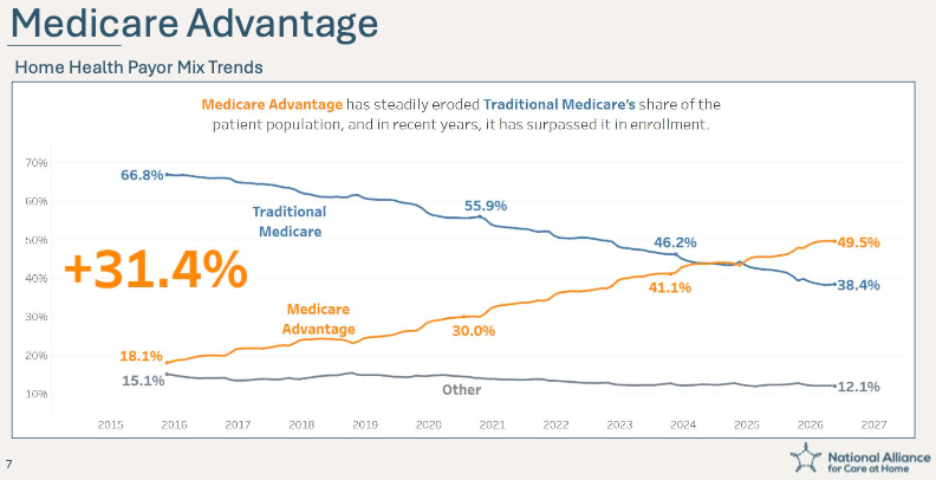
MA now accounts for 49.5% of patients in Homecare Homebase’s dataset, a 31% increase since 2016. Pearson described that growth as a structural change requiring providers to reconsider how they operate.
“Most organizations built their staffing, their workflows, and their contracts when traditional Medicare was two thirds of their business,” she said.
Homecare Homebase provides technology and administrative services to the home-based care sector.
Traditional Medicare margins have remained relatively steady since the implementation of the Patient-Driven Groupings Model (PDGM), while the cost-report category that includes MA has consistently operated at a loss, according to Nick Seabrook, executive vice president of SimiTree.
That category also includes other payers, meaning its results do not isolate MA performance.
“Medicare is really our only payer source in home health that’s making any kind of a positive margin,” Seabrook said on the panel.
When PDGM was first implemented, overall margins were around 7%, he said, referencing CMS data through 2024. Over the last three years, margins have hovered around 3%.
SimiTree offers consulting, technology and billing services for home healthcare, hospice and behavioral health providers.
Rising visit costs add another challenge. Seabrook reported that total RN visit costs approached $230, approximately $60 higher than at PDGM’s inception.
Still, opportunities exist for providers to negotiate episodic, Medicare-like MA contracts rather than accept per-visit reimbursement. Seabrook said plans have become more receptive to those arrangements.
“I would encourage you to reach out to your Medicare Advantage plans now to start that negotiation process to see if they would be receptive to a Medicare-like reimbursement rather than that per-visit model,” Seabrook said.
As providers negotiate, they should be ready to provide payers with clinical outcomes.